OpenAI's perplexity chart: Microsoft's MAI-2 Base fits at 0.819, Thinking Machines' and Qwen's bits per byte don't
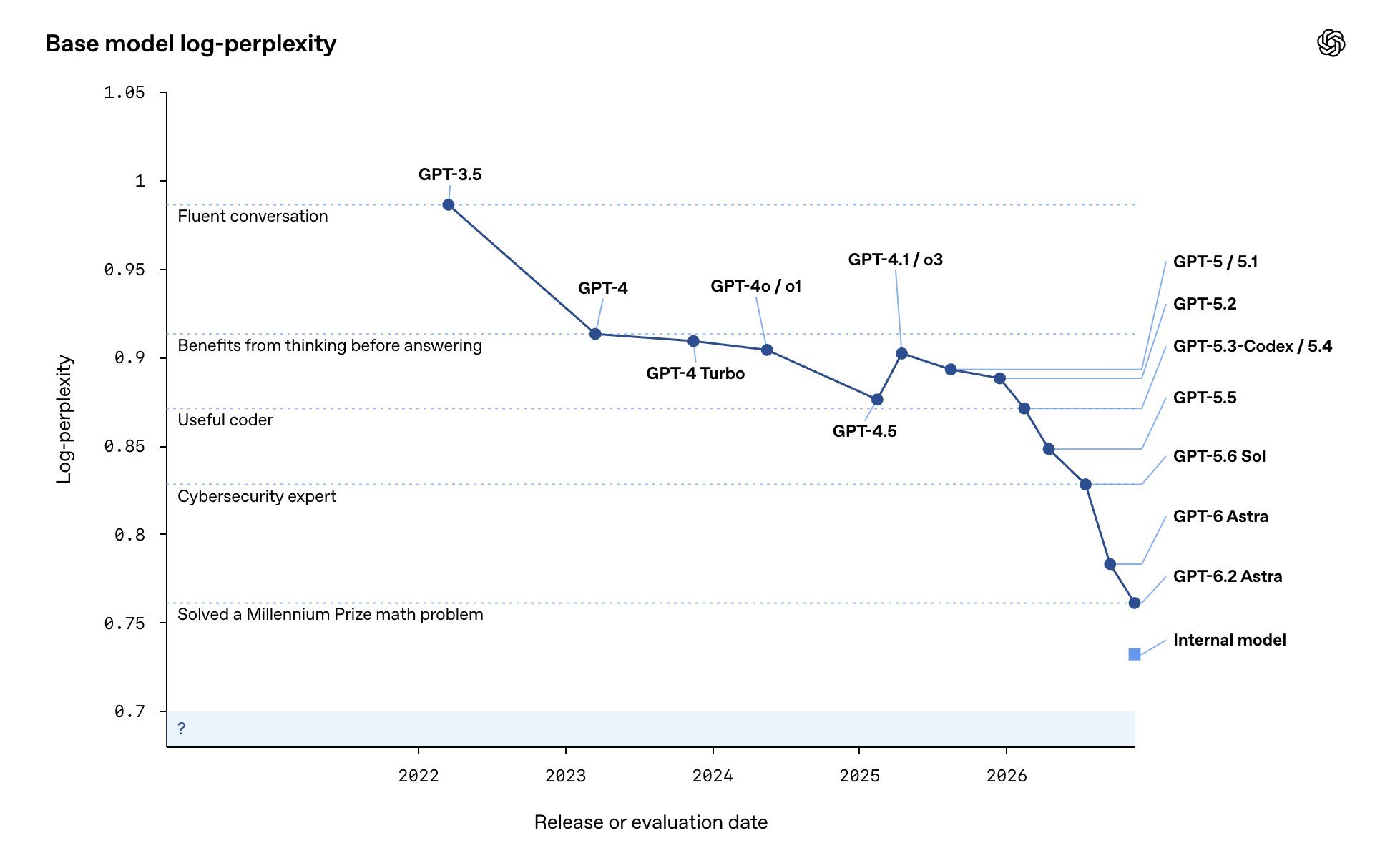
On November 22 Jakub Pachocki, OpenAI's chief scientist, published "Perplexity and Intelligence". It contains a chart OpenAI has not shown before: the log-perplexity of its base models on a held-out snapshot of OpenAI's internal codebase, from GPT-3.5 at 0.986 to GPT-6.2 Astra at 0.761, plus an unreleased internal model at 0.732. Pachocki proposes that labs report this kind of number and agree on "common limits, based on perplexity and other measurements," that they would not cross until monitoring catches up.
The next day Mustafa Suleyman, who runs Microsoft AI, put a second lab on the chart. MAI-2 Base scores 0.819 on OpenAI's evaluation set, close to the GPT-5.6 Sol base model at 0.828.
We fully support OpenAI's transparency initiative. Thanks to @merettm @markchen90 @gdb @sama for leading the way.
We all got into this field to build safe AGI that is genuinely good for humanity. One of the hardest parts of AI safety is coordination, and this is a step in the… https://t.co/JNGT3o3zrK pic.twitter.com/1NbJyxWZtG
Two other labs already publish pretraining loss on their own code: Thinking Machines with Inkling 2 Small on November 5 and Qwen with Qwen4-Max on November 16. Their numbers are in bits per byte and cannot be placed on OpenAI's chart. I took the exact values from the data behind OpenAI's chart, checked which tokenizer each plotted model uses, and measured on public code how much OpenAI's own tokenizer change moves the numbers.
The numbers
The essay text gives rounded values (~0.99, ~0.91, ~0.76). The chart on the page is drawn from an embedded Vega-Lite dataset with three decimals:
| Model | Date on chart | Log-perplexity |
|---|---|---|
| GPT-3.5 | 2022-03 | 0.986 |
| GPT-4 | 2023-03 | 0.913 |
| GPT-4 Turbo | 2023-11 | 0.909 |
| GPT-4o / o1 | 2024-05 | 0.904 |
| GPT-4.5 | 2025-02 | 0.876 |
| GPT-4.1 / o3 | 2025-04 | 0.902 |
| GPT-5 / 5.1 | 2025-08 | 0.893 |
| GPT-5.2 | 2025-12 | 0.888 |
| GPT-5.3-Codex / 5.4 | 2026-02 | 0.871 |
| GPT-5.5 | 2026-04 | 0.848 |
| GPT-5.6 Sol | 2026-07 | 0.828 |
| GPT-6 Astra | 2026-09 | 0.783 |
| GPT-6.2 Astra | 2026-11 | 0.761 |
| Internal model | 2026-11 | 0.732 |
Lower is better. From GPT-3.5 to GPT-5.2 the loss fell by 0.098 over about three and a half years. From GPT-5.2 to GPT-6.2 Astra it fell by 0.127 in eleven months. In a footnote Pachocki attributes the 2026 acceleration "mostly to the outcomes of long term research and compute investments, and only in a smaller part to automation." GPT-4.5 sits below the GPT-4.1 / o3 point that came after it (0.876 against 0.902). The essay does not comment on that.
The capability names on the horizontal lines come from the plotted models themselves. In the chart data, each of the five lines sits exactly on a model's score: "Fluent conversation" at GPT-3.5's 0.986, "Benefits from thinking before answering" at GPT-4's 0.913, "Useful coder" at 0.871 (GPT-5.3-Codex / 5.4), "Cybersecurity expert" at 0.828 (GPT-5.6 Sol) and "Solved a Millennium Prize math problem" at 0.761 (GPT-6.2 Astra). They mark the model at which OpenAI places each capability, not thresholds estimated separately. Pachocki says as much: it "was not at all clear a priori that these capabilities would appear once those precise perplexity thresholds are met." The shaded band at 0.68–0.70 is marked "?". It is his extrapolation of where "further transformative capabilities" should appear.
Why the tokenizer matters, and how much it matters here
Perplexity is computed per token, so two models that split the same text into different numbers of tokens get different numbers even when they predict the text equally well. Suleyman's post rests on this: "Our model uses the same tokenizer as OpenAI, so the numbers are directly comparable." Several replies to Pachocki raised the same point about OpenAI's own line, which crosses a tokenizer change.
OpenAI's tokenizer library, tiktoken, maps GPT-3.5 and GPT-4 to cl100k_base, and GPT-4o, o1, o3, GPT-4.1, GPT-4.5 and the gpt-5 prefix to o200k_base. GPT-6 models are not in the table. By that table, the chart's first three points use one tokenizer and at least the next eight use another. The essay doesn't say whether the numbers are normalized to a common token count. Suleyman's remark suggests they are not.
I measured how differently the two tokenizers split code. I took about 40 MB of Python from CPython, vLLM and Hugging Face Transformers, 17 MB of TypeScript from microsoft/TypeScript, and 40 MB each of Go and Rust from the Go and Rust repositories (shallow clones from November 23–24), and counted tokens with tiktoken 0.14.0:
| Code | Bytes per token, o200k_base |
o200k_base tokens vs cl100k_base |
|---|---|---|
| Python | 4.24 | +0.64% |
| TypeScript | 3.87 | +0.17% |
| Go | 2.97 | −0.17% |
| Rust | 3.82 | +0.05% |
On code the switch changes token counts by less than 1%. I expected a vocabulary twice the size to produce noticeably fewer tokens, and on these four languages it doesn't. For most of OpenAI's chart that makes the tokenizer a rounding issue: the 2026 steps are 0.017–0.045 each.
The one step it could erase is GPT-4 Turbo to GPT-4o, which is only 0.005. If the internal codebase tokenizes like my Python sample, GPT-4o's 0.904 per o200k_base token corresponds to about 0.910 per cl100k_base token, level with GPT-4 Turbo's 0.909. That depends on two things I cannot check: the language mix of OpenAI's code and whether the plotted values are per-token in each model's own tokenizer.
Bits per byte and what still doesn't line up
Thinking Machines and Qwen avoid the tokenizer problem by reporting bits per byte: total loss in bits divided by the number of bytes of text. The Inkling 2 Small announcement charts "Internal Code, Cutoff 2026-06" for seven models. Inkling 2 Small pre-trained is lowest at 0.2030; DeepSeek V4 Pro Base (0.2335) and GLM-5.3 (0.2358) are at the top, with Kimi K3.1 Pro, DeepSeek V4.1 Flash and GLM-5.3 Flash in between. Where only a post-trained checkpoint existed, the lab first fine-tuned it on "pretrain-formatted code and documents" to recover a base-like model, which it labels "base-recovered". Qwen's Qwen4-Max blog reports in-house bits-per-byte checks in which Qwen4-Max-Base is about 5–13% lower than Qwen3.8-Max-Base; we covered that release.
Converting OpenAI's numbers needs one more fact OpenAI hasn't published: how many bytes a token covers in its snapshot. Assuming the loss is in nats, the usual unit for training loss (the essay does not state the log base), bits per byte is the log-perplexity divided by ln 2 and by bytes per token. With my measured o200k_base ratios, GPT-6.2 Astra's 0.761 becomes 0.26 bits per byte if OpenAI's code tokenizes like Python and 0.37 if it tokenizes like Go. Even converted, it can't be set against Thinking Machines' 0.20–0.24, which comes from a different set of code. A chart by frontierlog.ai, which circulated on X on November 23, puts DeepSeek-V4-Pro-Base at 0.2335 bits per byte on Thinking Machines' set and 0.204 on Qwen's. That is the same model, 0.03 apart, on two private corpora. I confirmed the Thinking Machines figure on its page but could not render Qwen's blog to check the other.
Suleyman points at both gaps: labs "might need to report bits-per-byte (BPB) rather than perplexity," and they "will also need different evaluation datasets - the fact we have access to OpenAI's evaluation dataset is a special case." Mark Chen of OpenAI wrote that "there's still work (perhaps by 3P evaluators) to measure perplexities over the same datasets."
The dataset also decides what the number measures. Michael Mayer, in "I, too, can make a chart of perplexity drops", points to "Data Mixing Laws" (Ye et al.), where raising the share of code in a 160M model's training mix lowered its loss on code and raised it on other text. A model trained heavily on code, or on code that resembles OpenAI's, can score better on this chart without being better at anything else. Pachocki concedes the point only for GPT-2 and GPT-3, whose code loss he calls "a poor proxy for their general capabilities."
What can be checked from outside
Nobody outside OpenAI and Microsoft can compute a number on this scale: the snapshot is private, and the tokenizer of the newest models is not public. MAI-2 Base against GPT-5.6 Sol is the only cross-lab comparison on the chart that holds, and it holds because Microsoft had OpenAI's data and tokenizer. Publishing the snapshot's byte and token counts would let anyone put OpenAI's line into bits per byte. A shared limit of the kind Pachocki proposes would still need a held-out set that every lab can score and none has trained on. Neither the essay nor Microsoft's reply names one.
- Perplexity and Intelligence (Jakub Pachocki, OpenAI)
- Jakub Pachocki on X announcing the essay
- Mustafa Suleyman on X: MAI-2 Base 0.819 on OpenAI's evaluation set
- Mark Chen on X on disclosing perplexity results
- Thinking Machines: Inkling 2 Small (bits-per-byte chart, internal code)
- tiktoken model-to-encoding table
- Michael Mayer: I, too, can make a chart of perplexity drops
- Data Mixing Laws (Ye et al.)
Comments
No comments yet. Be the first.